
Automatic changeover for the equipment that can't stop.
The Smart Panel AC4 runs up to four CRAC units, rooftop units, pumps or other redundant equipment as one system. It rotates lead and standby to share the wear, starts a standby the moment a running unit alarms, and brings more units online as the temperature climbs.
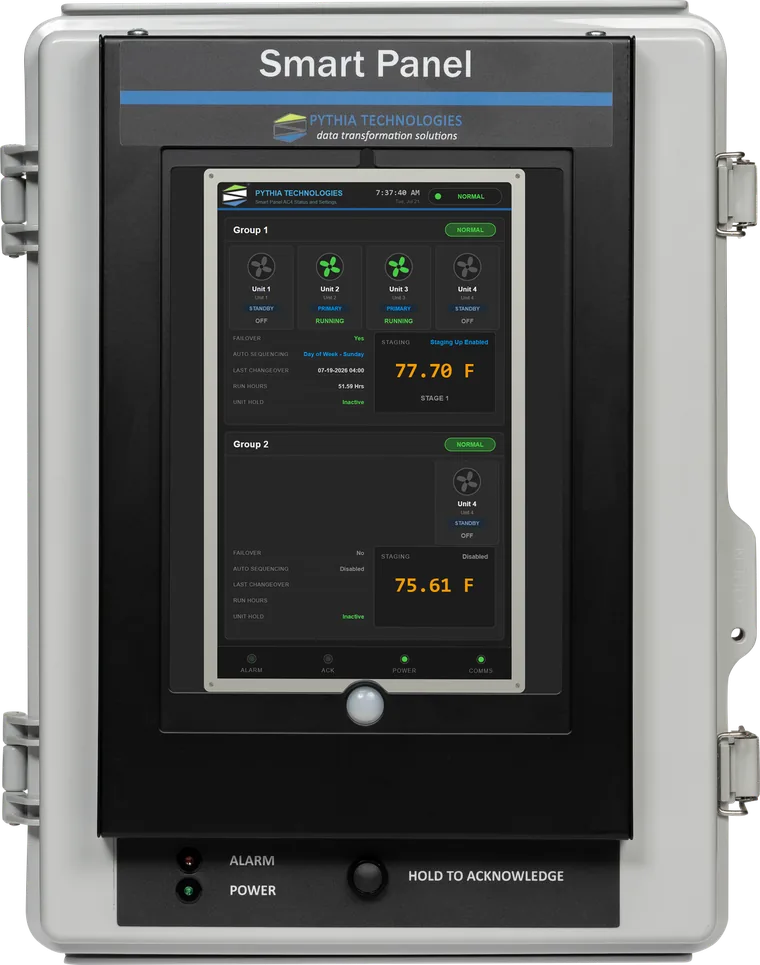
Shares the load across redundant units, and covers the moment one fails.
Running the same unit all the time wears it out years before its twin, and a failed unit at 2 a.m. shouldn't wait for someone to notice.
The SPAC4 watches each unit's summary alarm, switches units on and off through its own relays, and reports everything it does at the panel, in a browser and in your BMS.
Failover, changeover and staging in one panel.
Failover
When a running unit alarms, the panel starts a standby and stops the faulted unit. Roles return when the alarm clears, or stay put until someone acknowledges.
Auto changeover
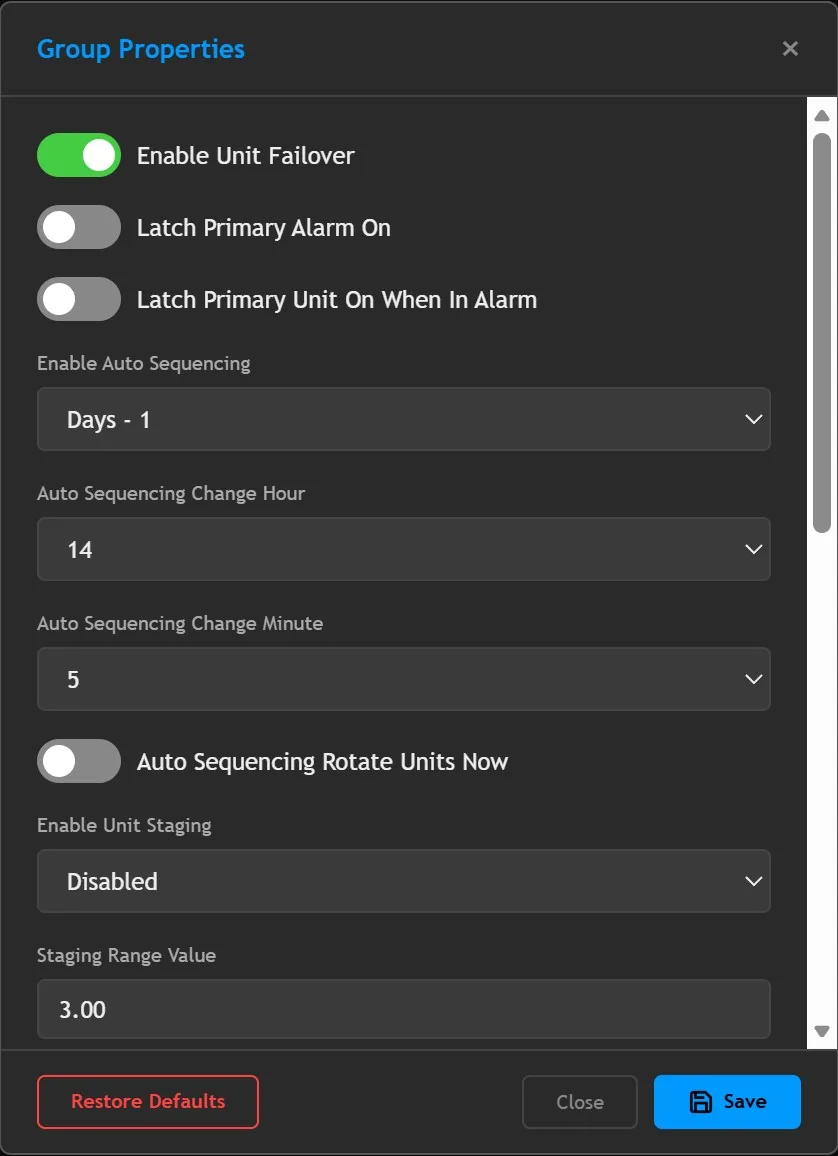
Lead and standby rotate every 12 hours, every set number of days, or on a chosen day of the week or month, so runtime is shared.
Temperature staging
Up to four setpoints per group add units as the space heats up (cooling) or cools down (heating), with a range that stops short-cycling.
Standby exercise
A standby unit runs on a schedule, for up to an hour, so a seized fan or stale coil shows up before you need the unit.
One panel, two systems
Split the four units into two groups, each with its own failover, changeover schedule, staging and sensor.
Alarms you can hear and see
Alarm and power indicators, an audible alarm and hold-to-acknowledge, plus a common alarm relay for your BMS or annunciator.
Two front panels. The same control.
Both models run the same changeover, failover and staging logic, publish the same data and serve the same web pages. Choose by what the people standing in front of the panel need to see.
SPAC4
An iPad display in the door shows the live status page. Configure groups and units at the panel, without a laptop. Also configured and monitored over the network.
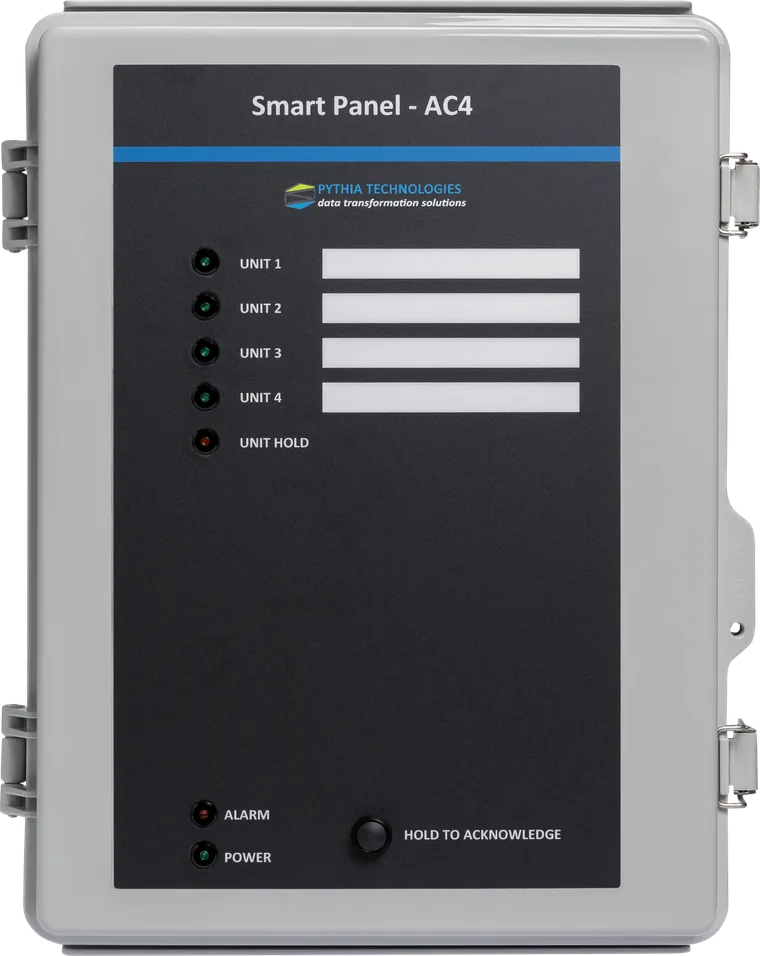
SPAC4-LED
An LED and write-on label for each unit, plus a Unit Hold LED. Configured and monitored over the network from any browser. Suited to plant rooms where nobody needs a screen.
Every unit's state at the panel, in a browser and in your BMS.
Each panel serves its own live status page and configuration console over the network. It publishes panel, group and unit states and sensor values over BACnet/IP, Modbus/TCP and SNMP, and sends email, text and SNMP trap alerts.
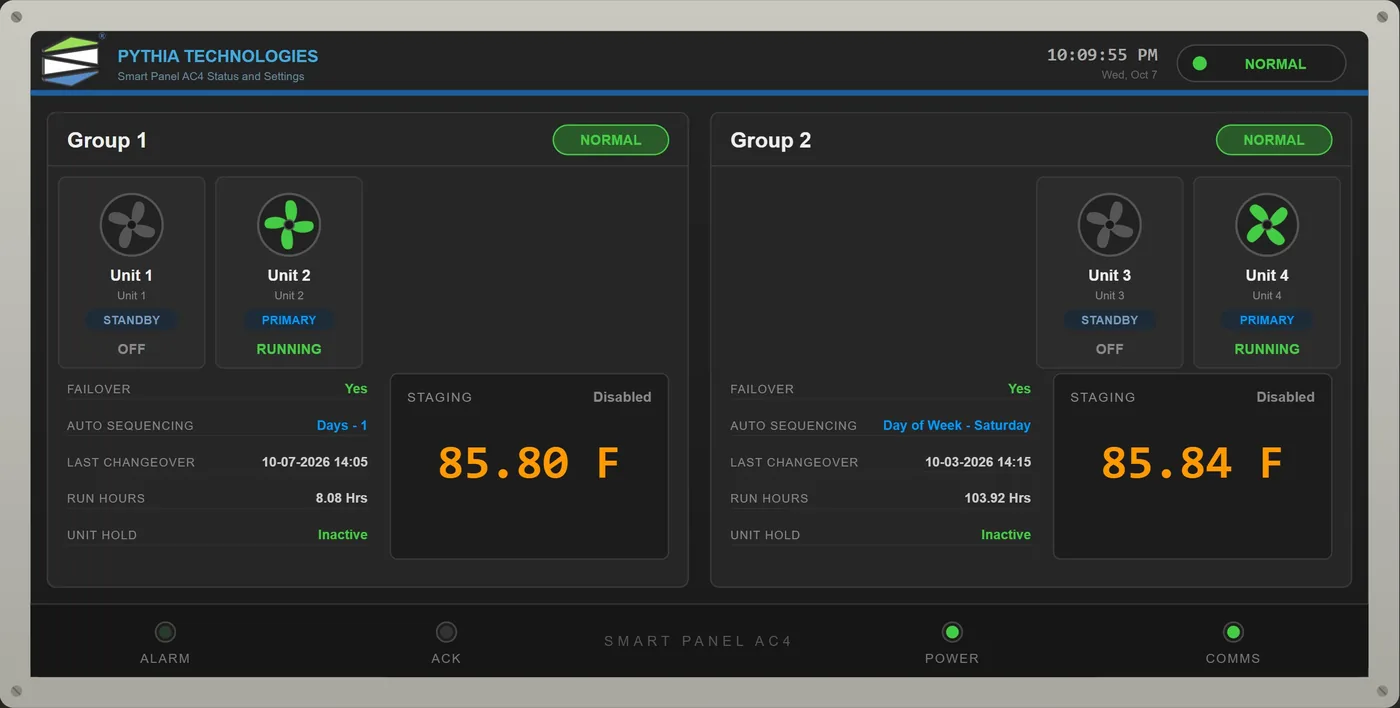
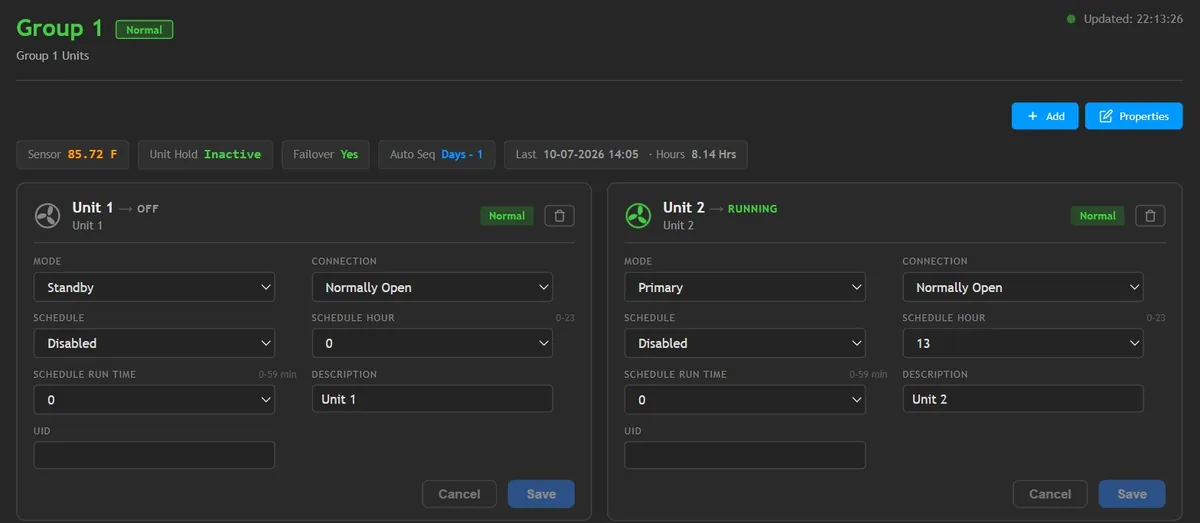
From a lead/lag pair to a four-stage capacity bank.
Lead/lag CRAC pair
One unit runs and the roles swap every week. Past 85°F the standby joins in. If the running unit alarms, the standby takes over.
Critical pair, latched failover
A fault that clears itself is never trusted silently. The standby keeps running until a technician acknowledges the alarm.
Three rooftop units, N+1
Roles rotate one position each week, so every unit takes a turn as the rested spare. The third unit starts on a fault or high temperature.
Two systems on one panel
A CRAC pair and a pump pair, each with its own schedule, failover rules, staging and sensor.
Four-stage capacity bank
All units start off. One unit comes on at each setpoint and drops out as the space cools.
Liebert AC4 replacement
Works with each unit's existing summary alarm contact and on/off control, and adds the remote visibility the original never had.
SPAC4 and SPAC4-LED.
| Control | |
|---|---|
| Units and groups | Up to 4 units, in 1 group or split across 2 independent groups |
| Unit modes | Primary, Standby, On (forced on) and Off (forced off) |
| Failover | Driven by each unit's summary alarm. Optional latching of the primary alarm, and of the primary unit on while in alarm |
| Auto changeover | Every 12 hours, every set number of days, or on a day of the week or month, at a set hour and minute. Rotate on demand |
| Temperature staging | Up (cooling) or down (heating), 4 setpoints per group, adjustable staging range, optional staging alarm |
| Standby exercise | Scheduled run for standby units, up to an hour, at a set start hour |
| Timers | Alarm delay time and unit hold (cycle) time |
| Inputs and outputs | |
| Unit alarm inputs | 4, voltage-free dry contact only. Up to 1,000 ft with Belden 6300UE |
| Unit control relays | 4, Normally Open or Normally Closed. 6 A at 250 VAC, 6 A at 30 VDC. Class 2 circuits only |
| Common alarm relay | 1, Normally Open or Normally Closed, same rating |
| Temperature inputs | 2, one per group. Type II 10K thermistor, °F or °C |
| At the panel | SPAC4: iPad display. SPAC4-LED: unit 1–4 and Unit Hold LEDs. Both: alarm and power indicators, buzzer, hold-to-acknowledge button |
| Network and integration | |
| Web | Live status page and configuration console, served by the panel |
| Protocols | BACnet/IP, Modbus/TCP and SNMP (MIB available) |
| Notifications | Email, text and SNMP traps. Alarm history kept on the panel |
| AI Connector | Available for the SPAC4 |
| Physical | |
| Enclosure | ABS, IP67 rated, UL94-V0. SPAC4: 16.25 × 13 × 7.5 in |
| Power | 120 VAC standard. 24 VAC and 48 VDC optional. The processor module requires UPS and/or inverter protection |
| Environment | −30 to 45 °C (−22 to 113 °F) inside the enclosure. 5 to 95% RH, non-condensing |
| Recommended wiring | Belden 6300UE for dry contacts, Belden 6300FE for communications |
Specifications are subject to change. Call for alternative assemblies and options.
Ask the panel what's running.
Connect Claude, ChatGPT or any assistant that speaks MCP. It answers from the panel's live data and can make changes only where you allow it.
The assistant wants to change equipment at your site:
Smart Panel AC4 questions, answered.
What is the Smart Panel AC4 (SPAC4)?
The Smart Panel AC4 is an automatic changeover panel that runs up to four CRAC units, rooftop units, pumps or other redundant equipment as one system. It rotates lead and standby units on a schedule, starts a standby when a running unit alarms, and stages more units online as temperature rises.
Can the SPAC4 replace a Liebert AC4 changeover panel?
Yes. The SPAC4 is a direct, modern replacement for the legacy Liebert AC4 changeover panel. It works with each unit's summary alarm contact and on/off control, and adds remote monitoring and BMS integration.
What equipment can the SPAC4 control?
Redundant equipment with a summary alarm contact and an on/off control input, such as CRAC and CRAH units, rooftop units, condensers, dry coolers and pumps. Up to four units can be in one group or split across two independent groups.
How does SPAC4 failover work?
Each unit's voltage-free summary alarm is wired to the panel. When a running unit alarms, the panel starts a standby unit and stops the faulted one. The primary alarm can optionally be latched so the standby keeps running until someone acknowledges the alarm.
How often can the SPAC4 rotate lead and standby units?
Every 12 hours, every set number of days, or on a chosen day of the week or month, at a set hour and minute. Units can also be rotated on demand. A standby unit can also be exercised on a schedule for up to an hour.
Does the SPAC4 do temperature staging?
Yes. Each group supports up to four temperature setpoints for staging up (cooling) or staging down (heating), with an adjustable staging range to prevent short-cycling. Staging uses a Type II 10K thermistor, in degrees F or C.
How does the SPAC4 connect to a BMS?
The SPAC4 publishes panel, group and unit status and sensor values over BACnet/IP, Modbus/TCP and SNMP, and sends email, text and SNMP trap notifications. It also has a common alarm relay output. Each panel serves a live status page and a configuration console in a web browser.
What is the difference between the SPAC4 and the SPAC4-LED?
Both run the same changeover, failover and staging logic and publish the same data. The SPAC4 has an iPad display in the door for live status and configuration at the panel. The SPAC4-LED has a status LED and write-on label for each unit and is configured over the network.
Call for pricing.
Contact us for a demo or pricing, and we'll confirm the right configuration for your site.